Oil & Gas

Detect SRB in 1–24 hours. Not weeks.

Sulfate-reducing bacteria drive microbially influenced corrosion, reservoir souring, and H2S generation across oil and gas operations. The serial dilution test—the current standard—takes weeks to confirm a positive result, long after the treatment window has closed. Retego Certus™ SRB returns quantitative microbiology data in 1–24 hours so you can optimize biocide, cut failures, and reduce maintenance spending.

The cost of waiting.

Corrosion costs US oil and gas production an estimated 1.4 billion dollars a year. A significant share is microbially influenced corrosion driven by sulfate-reducing bacteria. SRB doesn't announce itself. By the time iron sulfide fouls a separator or H2S spikes a meter, the colony has been growing for weeks or months.

Sending samples to a lab adds days and cost, and risks degradation in transit. Faster methods exist, but they carry their own tradeoffs in cost, field readiness, and accuracy.

Every one of those workflows assumes you have time you don't actually have.

Retego Certus™ SRB

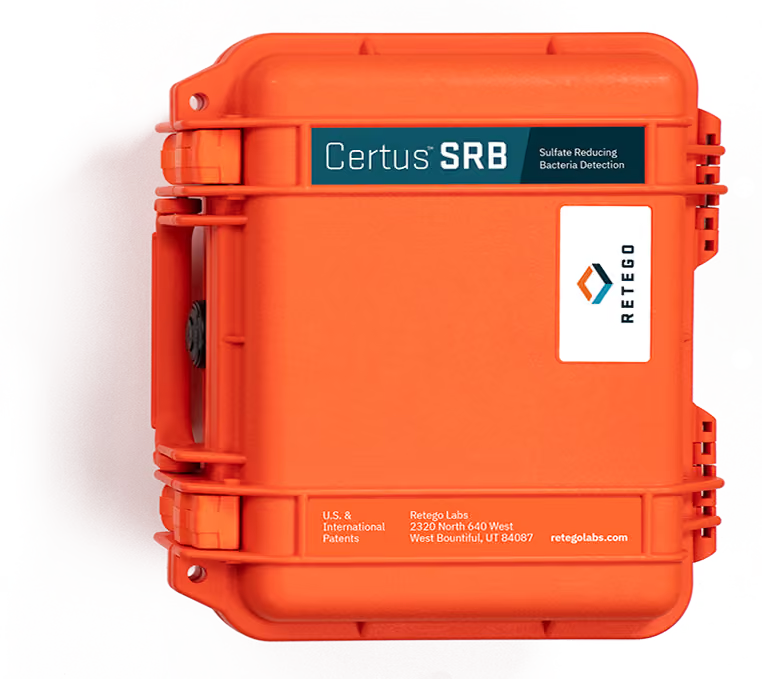
Retego Certus SRB returns a quantitative sulfate-reducing bacteria count in 1 to 24 hours, from a sample run where it was taken. Purpose-built for oilfield conditions: collect produced water, frac flowback or pipeline samples at the source and run the assay in the field. No shipping, no laboratory.

An aerial view of a Retego Certus SRB case. It is a hardened bright orange field case with identifying labels.
  • Detection: Quantitative, sulfate-reducing bacteria
  • Result turnaround: 1–24 hours
  • Sample volume: 3 mL
  • Sample types: Produced water, frac flowback, pipeline samples, industrial process water
  • PPE: Minimal, standard field PPE
  • Patent protection: Patent pending in the US and other major markets
  • Methodology: ASTM-aligned, peer-reviewed

Questions? Send us a message sales@retegolabs.com

Learn more

Retego Certus™ SRB delivers SRB-specific results in 1–24 hours, in the field.

MethodTime to ResultLocationKey drawback
Retego Certus™ SRB1–24 hoursFieldSRB-specific
Serial dilutionUp to 28 daysLabToo slow to inform a treatment decision
ATPMinutesFieldDetects non-bacteria species
qPCRHoursLabExpensive equipment

60+ parameters. One device.
The comprehensive corrosion chemistry suite.

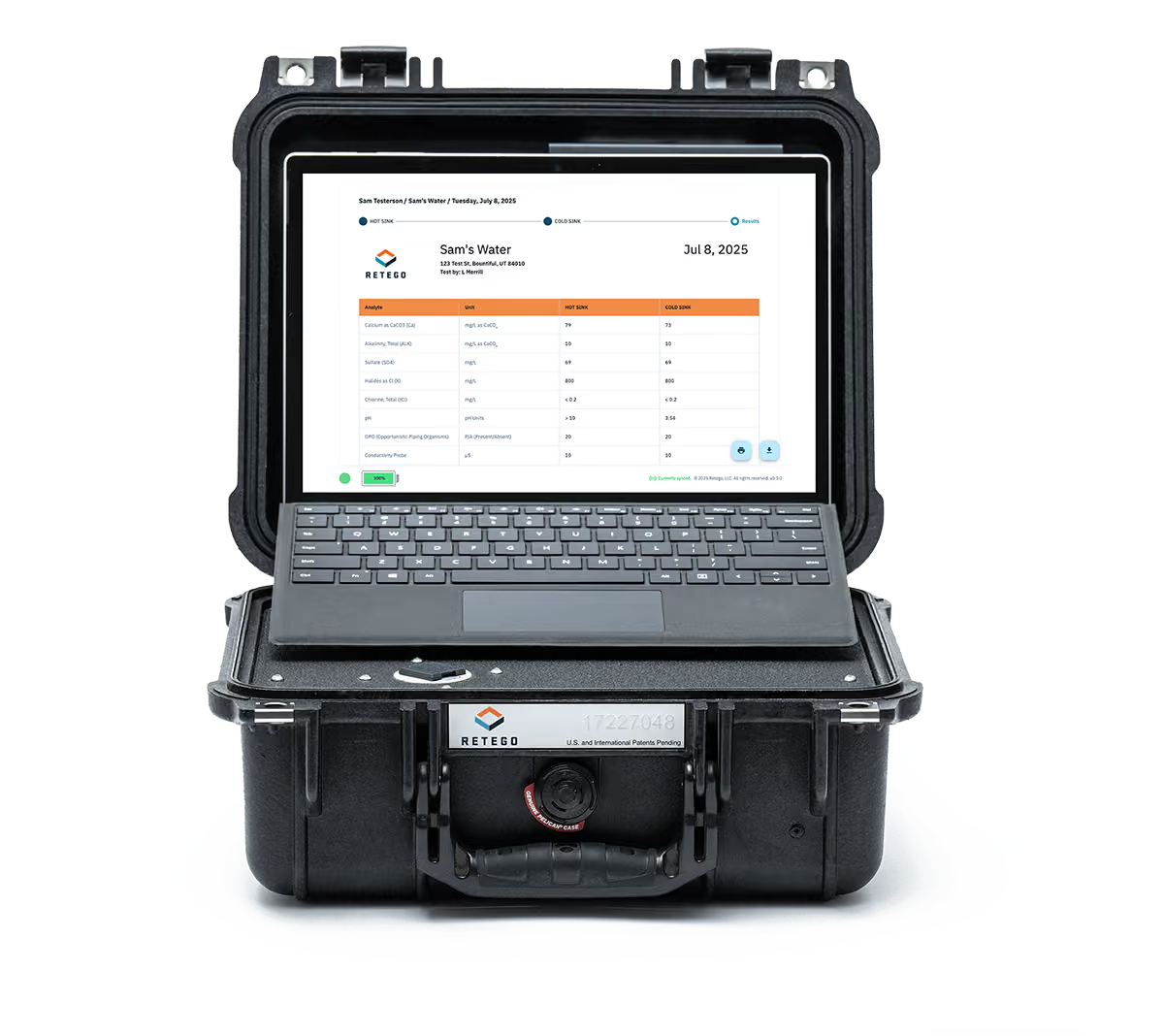
A Retego Aegis device opened showing test results in the Retego app. The case is a black hard plastic.

SRB is not the only concern. Retego Aegis™ gives you the information you need to make a treatment decision:

Retego Aegis runs Retego’s cuvette chemistry across minerals, corrosion drivers, and general water chemistry, returning a quantitative result for each in minutes. The detector measures the full chemistry and corrosion picture, grouped below.

  • Iron and metals: ferrous iron (Fe2+), ferric iron (Fe3+), total iron, low level iron, manganese, copper, lead, chromium (Cr(VI)).

  • Corrosion and scale drivers: sulfide (H2S), sulfate (SO4), chloride, halide, alkalinity, calcium hardness, magnesium.

  • General chemistry: pH, conductivity, total dissolved solids, dissolved oxygen, turbidity, ammonia, nitrate, nitrite, phosphate, sodium, potassium, barium, boron, chlorine (free, total, residual). Specialty: PFAS/PFOS, perchlorate, fat oil and grease.

  • Predictive indices (calculated in the Retego app): Langelier, Puckorius, Ryznar, aggressive index, chloride to sulfate mass ratio, sodium adsorption ratio, dissolved inorganic carbon.

Analytes
Calculations
  • Alkalinity, Total (ALK)
  • Ammonia (NH3)
  • Bacteria (Rapid Presence / Absence)
  • Barium (Ba)
  • Boron (B)
  • Calcium Hardness (Ca‐H)
  • Chlorine, Active
  • Chlorine, Residual
  • Chlorine, Total
  • Copper (Cu)
  • Fat, Oil & Grease (FOG)
  • Halide, as Chloride (X)
  • Iron, Ferrous (Fe2+)
  • Iron, Low Level (tFe)
  • Iron, Total (xFe)
  • Lead (Pb)
  • Nitrate (NO3)
  • Nitrite (NO2)
  • Perchlorate
  • PFAS ‐ PFOS (as Total Organic Fluorine)
  • pH (pH)
  • Phosphate (PO4)
  • Potassium
  • Sulfate (SO4)
  • Sulfide (H2S)
  • Sulfate Reducing Bacteria
  • Aggressive Index
  • Chloride/Sulfate Mass Ratio
  • Dissolved Inorganic Carbon
  • Iron, Ferric (Fe3+)
  • Langelier Saturation Index
  • Puckorius Scaling Index
  • Ryzner Stability Index
  • Sodium
  • Sodium Adsorption Ratio
  • Total Dissolved Solids (TDS)
  • Magnesium (MgH)